A Blog to further the research of the Thienemann and Related Families

Ein Blog zur Förderung der Erforschung der Familien Thienemann und verwandter Familien

  • Photo Restoration

    Fotowiederherstellung

    Photographs themselves have histories.

    The cabinet card shown above, depicting the four daughters of Franz “Rudolf” Zeißig and Marie Luise Pauline Zeißig née Thienemann, was photographed by Bernhard Prill of Lübeck and Oldesloe, Schleswig-Holstein, circa 1891–1892.

    For this presentation, three different versions of the same image are shown side-by-side.

    The first image presents the cabinet card exactly as it survives today after more than 130 years of aging, fading, handling, and chemical change. This version documents the physical historical object itself.

    The second image is a careful digital restoration intended to reflect how the cabinet card probably appeared when originally produced in the late nineteenth century. Contrast, tonal range, and the original appearance of the mount have been gently restored while preserving the integrity of the original photograph.

    The third image is an AI-assisted color interpretation. This version does not claim to represent exact historical colors, but instead offers a modern visual interpretation of how the four girls may have appeared if photographed in color during their lifetimes.

    The Thienemann Archive preserves all three versions because each documents a different aspect of the photograph’s history:
    the surviving object,
    the restored historical image,
    and the modern interpretive reconstruction.


    The original cabinet card is owned and was donated to ThienemannArchive.org by Frigyes Herzog of Budapest, Hungary, the girls’ first cousin twice removed and the great-grandson of their mother’s brother, Heinrich “Ottó” Thienemann.
  • On This Day in the Thienemann Archive – 11 May

    An diesem Tag im Thienemann-Archiv – 11. Mai

    BORN/GEBOREN
    CHRISTOPH GOTTHOLD THIENEMANN (1722-1771)
    born 11 May 1722 in Etzdorf, Thüringen

    SOPHIE “ERNESTINE” FRIEDRICH née/geb. THIENEMANN
    (1760-1845)
    born 11 May 1760 in Großaga, Sachsen
    wife of/Frau von CHRISTIAN DANIEL FRIEDRICH

    CARL FERDINAND MAX HAUPTMANN (1858-1921)
    born 11 May 1858 in Ober-Salzbrunn, Schlesien
    husband of/Ehemann von MARIE GABRIELE “MARTHA” HAUPTMANN née/geb. THIENEMANN (1862-1939)

    JOHANNE AUGUSTE WESTKAMP née/geb. THIENEMANN
    (1872-1949)
    born 11 May 1872 in Düsseldorf, Nordrhein-Westfalen
    wife of/Frau von LUDWIG EMIL WESTKAMP (1871-)

    MARRIED/VERHEIRATET
    ERNESTINE WILHELMINE AUGUSTE THIENEMANN (1815-)
    and ERNST JULIUS WASSERMANN
    married 11 May 1837 in Altenburg, Thüringen

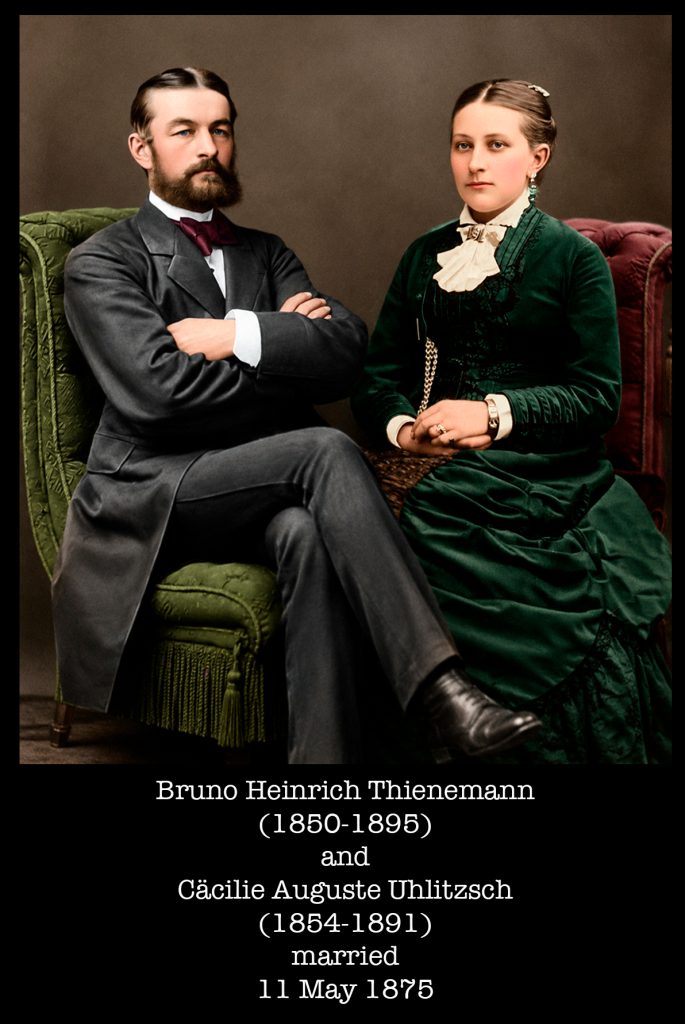
    BRUNO HEINRICH THIENEMANN (1850-1895)
    and CÄCILIE AUGUSTE UHLITZSCH (1854-1891)
    married 11 May 1875 place unknown (Ort unbekannt)

    DIED/GESTORBEN
    ANNA MARIA MAGDALENE THIENEMANN (1866-1867)
    died 11 May 1867 in Eilenburg, Sachsen

    DR. MED. KARIN PFÖRRINGER née/geb. THIENEMANN (1914-2004)
    died 11 May 2004 in Marquartstein, Bayern
    wife of/Frau von DR. MED. HERMANN PFÖRRINGER (1911-1981)

    BURIED/BEGRABEN

    HERMANN HEINRICH WILHELM THIENEMANN (1868-1869)
    buried 11 May 1869 in Oschersleben, Sachsen-Anhalt
  • On This Day in the Thienemann Archive – 10 May


    An diesem Tag im Thienemann-Archiv – 10. Mai

    BORN/GEBOREN
    ERNESTINE MAGDALENE ELEONORE THIENEMANN (1770-1777)
    born 10 May 1770 in Bremsnitz, Thüringen

    RUTH THIENEMANN née/geb. CZALINNA (1923-)
    wife of/Frau von WALTER HERMANN HEINRICH ARNHOLDT THIENEMANN (1924-1991)

    MARRIED/VERHEIRATET
    IDA HENRIETTE THIENEMANN (1835-1897)
    and EMANUEL OSWALD BRÜCKNER (1829-1883)
    married 10 May 1853 in Dresden, Sachsen

    DIED/GESTORBEN
    ANDREAS “DAVID” THIENEMANN (1773-1848)
    died 10 May 1848 in Groß Ottersleben, Sachsen-Anhalt

    AMALIE THIENEMANN née/geb. FISCHER (1805-1878)
    died 10 May 1878 in Gera, Thüringen
    wife of/Frau von FRIEDRICH ANTON THIENEMANN (1808-1868)

    EMIL “KURT” THIENEMANN (1904-1984)
    died 10 May 1984 in Halberstadt, Sachsen-Anhalt

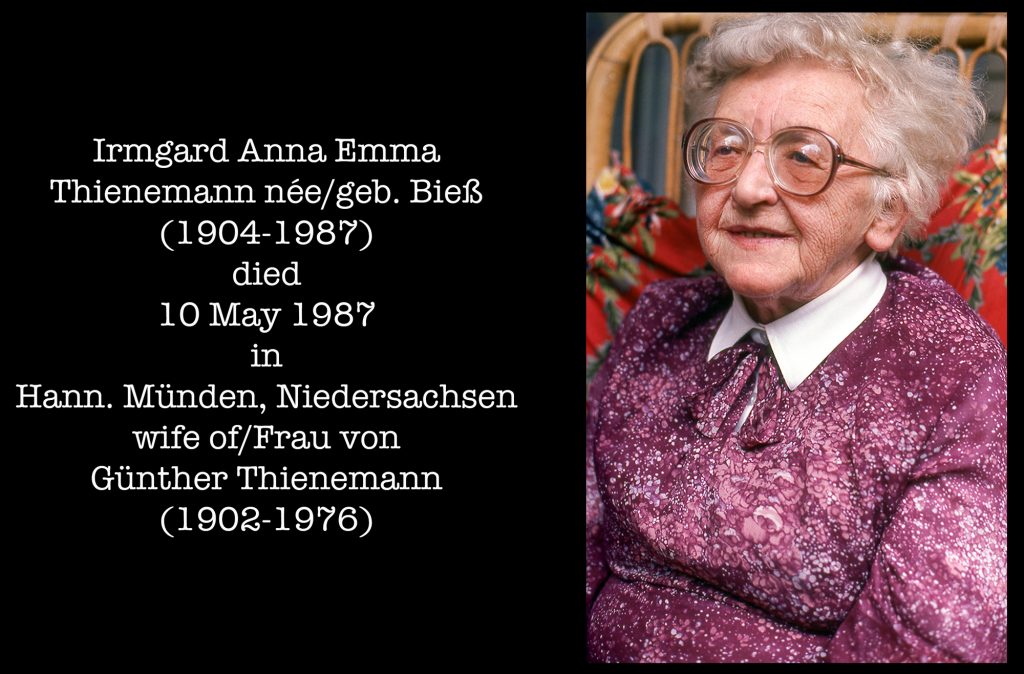
    IRMGARD ANNA EMMA THIENEMANN née/geb. BIESS (1904-1987)
    died 10 May 1987 in Hann. Münden, Niedersachsen
    wife of/Frau von GÜNTHER THIENEMANN (1902-1976)
  • Die häufigsten Vornamen im Thienemann Archiv (1661–heute)

    Eine der interessanteren Fragen, die diese Woche im Thienemann Archiv untersucht wurden, war folgende:

    Welche Vornamen wurden in der Familie in den vergangenen 365 Jahren am häufigsten verwendet?

    Auf Grundlage der aktuellen Archivdatenbank mit 1.417 dokumentierten Geburten mit den Familiennamen „Thieneman“ oder „Thienemann“ wurde eine Häufigkeitsanalyse aller aufgezeichneten Vornamen durchgeführt – von der frühesten dokumentierten „Thienemann“-Geburt im Jahr 1661 bis heute.

    Für diese Untersuchung wurden alle aufgezeichneten Vornamen einzeln gezählt und nicht nur der jeweils erste Vorname berücksichtigt. Dieser Ansatz spiegelt die traditionelle deutsche Namensgebung besser wider, bei der der tatsächlich verwendete „Rufname“ häufig nicht der erste eingetragene Taufname war.

    So könnte beispielsweise Carl Theodor Thienemann im Alltag einfach als „Theodor“ bekannt gewesen sein.

    Die Ergebnisse zeigen faszinierende Muster familiärer Namensgewohnheiten über Generationen hinweg und über verschiedene Kontinente hinweg.

    Die häufigsten männlichen Vornamen (1661–heute)

    1. Friedrich — 61
    2. Johann — 61
    3. Heinrich — 55
    4. August — 45
    5. Wilhelm — 40
    6. Ernst — 36
    7. Christian — 35
    8. Karl — 29
    9. Franz — 26
    10. Joseph — 23
    11. Theodor — 23
    12. Georg — 22
    13. Otto — 22
    14. Gustav — 21
    15. Hans — 20
    16. Christoph — 19
    17. Eduard — 19
    18. Rudolf — 19
    19. Andreas — 18
    20. Hermann — 18

    Die häufigsten weiblichen Vornamen (1661–heute)

    1. Marie — 47
    2. Elisabeth — 25
    3. Friederike — 25
    4. Johanne — 24
    5. Anna — 22
    6. Auguste — 22
    7. Christiane — 22
    8. Sophie — 21
    9. Wilhelmine — 20
    10. Dorothea — 18
    11. Emma — 18
    12. Hedwig — 18
    13. Margarethe — 18
    14. Clara — 17
    15. Helene — 17
    16. Pauline — 17
    17. Agnes — 16
    18. Bertha — 16
    19. Caroline — 16
    20. Martha — 16

    Die Moderne: 1900–heute

    Die Archivdaten zeigen außerdem einen deutlichen Wandel der Namensgewohnheiten im Verlauf des 20. Jahrhunderts, als verschiedene Familienzweige auswanderten, sich an neue Länder anpassten und andere sprachliche und kulturelle Einflüsse übernahmen.

    Traditionelle deutsche Namen wie Johann, Heinrich und Friederike wurden allmählich durch modernere und internationalere Namen ersetzt.

    Die häufigsten männlichen Vornamen (1900–heute)

    1. Joseph — 20
    2. Michael — 12
    3. Wilhelm — 11
    4. Charles — 9
    5. Albert — 8
    6. Robert — 8
    7. Walter — 8
    8. Edward — 7
    9. Ernst — 7
    10. Francis — 7
    11. Hans — 7
    12. Lee — 7
    13. Peter — 7
    14. Richard — 7
    15. Rolf — 7
    16. Friedrich — 6
    17. Heinz — 6
    18. Joachim — 6
    19. Karl — 6
    20. Ulrich — 6

    Die häufigsten weiblichen Vornamen (1900–heute)

    1. Marie — 19
    2. Ann — 12
    3. Mary — 11
    4. Elizabeth — 9
    5. Lynn — 7
    6. Ruth — 7
    7. Nicole — 6
    8. Elisabeth — 5
    9. Margaret — 5
    10. Rose — 5
    11. Donna — 4
    12. Gail — 4
    13. Lauren — 4
    14. Sarah — 4
    15. Ursula — 4
    16. Agnes — 3
    17. Alexandra — 3
    18. Barbara — 3
    19. Catherine — 3
    20. Eva — 3

    Was sagen uns diese Ergebnisse?

    Die früheren Jahrhunderte des Archivs werden deutlich von traditionellen deutschen Namensgewohnheiten geprägt. Namen wie Johann, Friedrich, Heinrich, Marie und Friederike tauchen über viele Generationen hinweg immer wieder auf. Häufig wurden Namen zu Ehren von Eltern, Großeltern oder Paten weitergegeben.

    Im Verlauf des 20. Jahrhunderts änderten sich die Namensmuster jedoch deutlich. Besonders in amerikanischen Familienzweigen wurden englischsprachige Namen zunehmend häufiger. Namen wie Michael, Charles, Robert, Ann und Mary ersetzten nach und nach viele der älteren deutschen Formen.

    Auf den ersten Blick wirken die modernen Listen stark amerikanisiert. Betrachtet man jedoch die zwanzig häufigsten Namen statt nur der ersten zehn, zeigt sich ein interessantes Bild: Viele traditionelle deutsche Namen blieben auch im 20. Jahrhundert weiterhin bemerkenswert häufig vertreten. Namen wie Hans, Friedrich, Heinz, Joachim, Karl, Ulrich, Ursula und Elisabeth erscheinen weiterhin in mehreren Familienzweigen – trotz neuer internationaler Namensgewohnheiten.

    Die älteren deutschen Namensformen verschwanden also nicht vollständig, sondern bestanden parallel zu neueren amerikanischen und internationalen Einflüssen weiter. Dies spiegelt sowohl kulturelle Kontinuität als auch die allmähliche Anpassung verschiedener Familienzweige über Generationen hinweg wider.

    Das Archiv enthält derzeit Aufzeichnungen zu 1.417 Geburten mit den Familiennamen „Thieneman“ oder „Thienemann“ zwischen 1661 und heute. Davon entfallen etwa 566 dokumentierte Geburten auf die Zeit nach 1900.

    Besonders bemerkenswert ist außerdem, dass trotz eines Zeitraums von mehr als dreieinhalb Jahrhunderten derzeit nur bei etwa 175 Personen kein genaues Geburtsjahr bekannt ist.

    Genealogie besteht oft scheinbar nur aus Namen und Daten. Doch manchmal erzählen gerade diese Namen selbst die Geschichte von Migration, Identität, Sprache, Religion und sich wandelnden Familientraditionen über Jahrhunderte hinweg.

    Abschließende Gedanken

    Erkennst du einige dieser Namen aus deinem eigenen Familienzweig wieder?

    Gibt es Vornamen, die sich in deiner Familie über mehrere Generationen hinweg wiederholt haben?

    Das Thienemann Archiv freut sich über Hinweise, Erinnerungen und Geschichten zu wiederkehrenden Familiennamen, Namensgewohnheiten und Familientraditionen, die über Generationen hinweg weitergegeben wurden.
  • The Most Common First Names in the Thienemann Archive (1661-present)


    One of the more interesting questions explored this week in the Thienemann Archive was this:

    What were the most common first names used in the family over the past 365 years?

    Using the current archive database of 1,417 documented births carrying the surnames “Thieneman” or “Thienemann, a frequency analysis was conducted of all recorded given names from the earliest documented “Thienemann” birth in 1661 through the present day.

    For this study, all recorded given names were counted individually rather than only the first listed name. This approach better reflects traditional German naming customs, in which the commonly used “Rufname” (called name) was often not the first baptismal name recorded.

    For example Carl Theodor Thienemann – may simply have been known as “Theodor”.

    The results reveal fascinating patterns in family naming traditions across generations and across continents.

    Most Common Male Names (1661–Present)

    1. Friedrich — 61
    2. Johann — 61
    3. Heinrich — 55
    4. August — 45
    5. Wilhelm — 40
    6. Ernst — 36
    7. Christian — 35
    8. Karl — 29
    9. Franz — 26
    10. Joseph — 23
    11. Theodor — 23
    12. Georg — 22
    13. Otto — 22
    14. Gustav — 21
    15. Hans — 20
    16. Christoph — 19
    17. Eduard — 19
    18. Rudolf — 19
    19. Andreas — 18
    20. Hermann — 18

    Most Common Female Names (1661–Present)

    1. Marie — 47
    2. Elisabeth — 25
    3. Friederike — 25
    4. Johanne — 24
    5. Anna — 22
    6. Auguste — 22
    7. Christiane — 22
    8. Sophie — 21
    9. Wilhelmine — 20
    10. Dorothea — 18
    11. Emma — 18
    12. Hedwig — 18
    13. Margarethe — 18
    14. Clara — 17
    15. Helene — 17
    16. Pauline — 17
    17. Agnes — 16
    18. Bertha — 16
    19. Caroline — 16
    20. Martha — 16

    The Modern Era: 1900–Present

    The archive also reveals a dramatic shift in naming traditions during the twentieth century as branches of the family migrated, assimilated, and adapted to new cultures and languages.

    Traditional German names such as Johann, Heinrich, and Friederike gradually gave way to more modern and international names.

    Most Common Male Names (1900–Present)

    1. Joseph — 20
    2. Michael — 12
    3. Wilhelm — 11
    4. Charles — 9
    5. Albert — 8
    6. Robert — 8
    7. Walter — 8
    8. Edward — 7
    9. Ernst — 7
    10. Francis — 7
    11. Hans — 7
    12. Lee — 7
    13. Peter — 7
    14. Richard — 7
    15. Rolf — 7
    16. Friedrich — 6
    17. Heinz — 6
    18. Joachim — 6
    19. Karl — 6
    20. Ulrich — 6

    Most Common Female Names (1900–Present)

    1. Marie — 19
    2. Ann — 12
    3. Mary — 11
    4. Elizabeth — 9
    5. Lynn — 7
    6. Ruth — 7
    7. Nicole — 6
    8. Elisabeth — 5
    9. Margaret — 5
    10. Rose — 5
    11. Donna — 4
    12. Gail — 4
    13. Lauren — 4
    14. Sarah — 4
    15. Ursula — 4
    16. Agnes — 3
    17. Alexandra — 3
    18. Barbara — 3
    19. Catherine — 3
    20. Eva — 3

    What Do These Results Tell Us?

    The earlier centuries of the archive are dominated by traditional German naming customs, especially the repeated use of names such as Johann, Friedrich, Heinrich, Marie, and Friederike. Many names were reused repeatedly across generations, often honoring parents, grandparents, or godparents.

    By the twentieth century, however, the family naming patterns changed dramatically. English-language names became increasingly common, especially in American branches of the family. Names such as Michael, Charles, Robert, Ann, and Mary began replacing many of the older German forms.

    At first glance, the modern-era lists appear heavily Americanized. Yet when the top twenty names are examined instead of only the top ten, an interesting pattern emerges: many traditional German names still remain remarkably common well into the twentieth century. Names such as Hans, Friedrich, Heinz, Joachim, Karl, Ulrich, Ursula, and Elisabeth continued to appear across multiple branches of the family even as newer generations adopted more international naming styles.


    Rather than disappearing entirely, older German naming traditions survived alongside newer American and international influences — reflecting both cultural continuity and gradual assimilation across generations.

    The archive currently contains records of 1,417 births with the surnames “Thieneman” or “Thienemann” between 1661 and the present day. Of those, approximately 566 documented births occurred after 1900.

    Even more remarkable: despite spanning more than three and a half centuries, only about 175 individuals in the archive currently lack an identifiable birth year.

    Genealogy is often thought of simply as names and dates. But sometimes, those names themselves tell the story of migration, identity, language, religion, and changing family traditions across centuries.

    Closing Thoughts

    Do you recognize any of these names from your own branch of the family?

    Are there names that appeared repeatedly in your parents’, grandparents’, or great-grandparents’ generations?

    The Thienemann Archive would be interested in hearing about recurring family names, naming traditions, and stories connected to the names that have been passed down through generations.

  • On This Day in the Thienemann Archive – 09 May

    An diesem Tag im Thienemann-Archiv – 9. Mai

    BORN/GEBOREN
    JOHANNA ROSINA THIENEMANN (1776-)
    born 09 May 1776 in Röpsen, Thüringen

    KARL KURT GÜNTHER THIENEMANN (1854-1925)
    born 09 May 1854 in Naumburg an der Saale, Sachsen-Anhalt

    RICHARD THIENEMANN (1876-1950)
    born 09 May 1876 in Schleibnitz, Sachsen-Anhalt

    RAINER SCHULZE (1950-1989)
    born 09 May 1950 in Magdeburg, Sachsen-Anhalt
    son of/Sohn von RUTH SCHULZE née/geb. THIENEMANN (1928-1985)

    MARRIED/VERHEIRATET
    ERNST THEODOR THIENEMANN (1763-1830) and CHRISTIANE AMALIA SALOME UHRLANDT
    married 09 May 1790 in Tinz, Thüringen

    DIED/GESTORBEN
    HANS GRANGÉ (1891-1915)
    died 09 May 1915 in Flanders, Belgium
    son of/Sohn von GRETE GRANGÉ née/geb. THIENEMANN (1863-1922)

    PAUL ERNST THIENEMANN (1869-1928)
    died 09 May 1928 place unknown (Ort unbekannt)
  • Lost German Cities of the Twentieth Century

    Graphic and original concept from the Facebook page of Dmytro Degtyaryov, “100 Jahre Zurück,” used with permission: https://www.facebook.com/100jahrezuruck. English text adapted and expanded for genealogical and historical reference purposes by ThienemannArchive.org.

    Note: The accompanying map is an AI-assisted historical infographic created for general visual reference purposes. It is intended to illustrate twentieth-century border and sovereignty changes affecting these cities and is not meant to represent exact historical boundaries or precise geographic locations.
    Over the last 100 years, wars, border changes, and international treaties dramatically reshaped the map of Central and Eastern Europe. Many cities that were once important cultural, industrial, and economic centers of Germany are today located in other countries. For genealogists and historians, understanding these historical place-name and border changes is essential when researching family records, documents, and archives.

    Here are ten of the largest and most historically significant cities that were formerly part of Germany during the twentieth century.

    1️⃣ Königsberg (today Kaliningrad, Russia 🇷🇺)
    The historic capital of East Prussia and home of philosopher Immanuel Kant. One of the most important cities of the former German East, it became part of the Soviet Union after the Second World War.

    2️⃣ Danzig (today Gdańsk, Poland 🇵🇱)
    A major Baltic seaport and famous Hanseatic city. Its political status after the First World War became one of the major sources of tension between Germany and Poland during the interwar period.

    3️⃣ Breslau (today Wrocław, Poland 🇵🇱)
    Until 1945, one of the largest cities in Germany. Breslau was an important cultural, architectural, and university center of Silesia.

    4️⃣ Straßburg (today Strasbourg, France 🇫🇷)
    The principal city of Alsace, with a long and complex French-German history. During the period of German administration, the monumental Neustadt district was constructed.

    5️⃣ Stettin (today Szczecin, Poland 🇵🇱)
    A major port city of Pomerania located near Berlin. Following the border changes after 1945, the city became part of Poland.

    6️⃣ Memel (today Klaipėda, Lithuania 🇱🇹)
    The northernmost port city associated with East Prussia. After the First World War, the Memel Territory was separated from Germany and later became part of Lithuania.

    7️⃣ Mülhausen (today Mulhouse, France 🇫🇷)
    An important industrial center in Alsace whose sovereignty shifted multiple times between France and Germany.

    8️⃣ Allenstein (today Olsztyn, Poland 🇵🇱)
    One of the principal cities of southern East Prussia, with deep historical ties to German and East Prussian heritage.

    9️⃣ Elbing (today Elbląg, Poland 🇵🇱)
    An old Hanseatic city and an important commercial center of historic East Prussia.

    🔟 Gleiwitz (today Gliwice, Poland 🇵🇱)
    A major industrial city of Upper Silesia, known historically for the 1939 Gleiwitz radio station incident that became one of the pretexts for the outbreak of the Second World War.

    🕊️ Many of these cities still preserve German-era architecture, churches, town halls, cemeteries, and traces of their multicultural past. Today they belong to different nations, yet they remain part of the complex and interconnected history of Europe.
  • On This Day in the Thienemann Archive – 08 May

    An diesem Tag im Thienemann-Archiv – 8. Mai

    BORN/GEBOREN
    CARL RENATUS THIENEMANN (1751-1803)
    born 08 May 1751 in Großaga, Sachsen

    KLARA PERLET (1861-)
    born 08 May 1861 in Waltershausen, Thüringen
    daughter of/Tochter von AUGUSTE PERLET née/geb. THIENEMANN (1834-1903)

    ELLA FRIEDERIKE MAJOR née/geb. THIENEMANN (1888-)
    born 08 May 1888 in Magdeburg, Sachsen-Anhalt
    wife of/Frau von FRIEDRICH LOTHAR MAJOR (1885-1918)

    MARRIED/VERHEIRATET

    MATHILDE CHRISTINE THIENEMANN and THEODOR PHILIPPEN
    married 08 May 1868 in Düsseldorf, Nordrhein-Westfalen

    RUDOLF KARL THIENEMANN (1904-1972)
    and ELISABETH ANNA STENZEL (1903-1972)
    married 08 May 1939 in Schwanbeck, Brandenburg

    DIED/GESTORBEN

    JOHANN FRIEDRICH THIENEMANN (-1851)
    died 08 May 1851 in Groß Wanzleben, Sachsen-Anhalt

    KARL “FRIEDRICH” THIENEMANN (1795-1867)
    died 08 May 1867 in Quirla, Thüringen

    HERMANN HEINRICH WILHELM THIENEMANN (1868-1869)
    died 08 May 1869 in Oschersleben, Sachsen-Anhalt

    BURIED/BEGRABEN
    MARIA “LOTTE” THIENEMANN née/geb. LOHMANN (1899-1981)
    buried 08 May 1981 in Friedhof Rüngsdorf, Bad Godesberg, Nordrhein-Westfalen
    wife of/Frau von ERNST LUDWIG THIENEMANN (1898-1964)
  • On This Day in the Thienemann Archive – 07 May


    An diesem Tag im Thienemann-Archiv – 7. Mai

    MARRIED/VERHEIRATET
    AGNES BERTHA HEDWIG THIENEMANN (1880-1957) and
    FRIEDRICH GOTTFRIED “EDMUND” TITTMANN (1869-1945)
    married 07 May 1910 in Oschersleben, Sachsen-Anhalt

    DIED/GESTORBEN
    CHARLOTTE HORN née/geb. THIENEMANN (1849-1918)
    died 07 May 1918 in Wanzleben, Sachsen-Anhalt
    wife of/Frau von FRIEDRICH HORN

  • Why the Archive Seeks Out and Preserves Lost Graves

    Creating a permanent record in places where permanence was never intended

    In many parts of the world, a grave is not a permanent place. In the United States—particularly in places such as New Orleans—cemeteries are understood as enduring spaces where names remain visible for generations. In much of Central and Eastern Europe, however, a grave often exists only for a defined period of time. When that period ends, the plot may be reused, the marker removed, and the inscription lost from the landscape.

    For the genealogist, the result is the same: a name once carved in stone is no longer visible. Without documentation, the connection between the individual and the physical place of burial can disappear entirely.

    The cemetery and headstone section of the Thienemann Archive exists to address this reality. Creating a permanent record in places where permanence was never intended is central to this work.

    Each photograph, transcription, and translation serves a specific purpose:

    • to preserve inscriptions that may no longer exist
    • to document graves that are partially obscured or deteriorating
    • to record locations that may later be altered or lost
    • to provide future researchers with reliable, verifiable information

    In many cases, the archival record becomes the only remaining evidence that a grave—and the individual it commemorated—ever existed.

    The archive presents grave images as documentary records of their condition at the time they were photographed.

    In some cases, inscriptions are difficult to read due to age, wear, lighting, or vegetation. Where helpful, additional versions may be provided to improve legibility.

    Modern digital tools, including AI-assisted methods, may be used for this purpose. These enhanced images are based on the original photograph and are intended to assist interpretation. They do not replace the original record.

    Improving Legibility

    The following example illustrates how original photographs are preserved and how enhanced versions may be used to improve legibility.

    Grave of Otto Wilhelm Thienemann, author of the 400-Year Birth Register of the Family Thienemann (formerly Dienemann and Duhnemann), whose genealogical work forms the foundation of the research presented in the Thienemann Archive, which, beginning in 1978, has continued and expanded upon his work.

    Located in the Hauptfriedhof Radebeul, Kreis Dresden, Sachsen.

    Left: Original grave photograph
    Right: AI-assisted enhanced image for improved legibility

    The enhanced image is provided to assist readability; the original photograph remains the primary record.

    The example above reflects a typical condition encountered in cemetery documentation: the inscription remains present, but is not easily readable in its original state.

    The removal of a grave marker does not erase the life it represents. Without documentation, however, it can erase the visible connection between past and present.

    The work of the archive is therefore straightforward in principle: to ensure that names, dates, and relationships remain accessible—even when the physical markers no longer do.

    Creating a permanent record in places where permanence was never intended.